
How corporations created the myth of personal responsibility
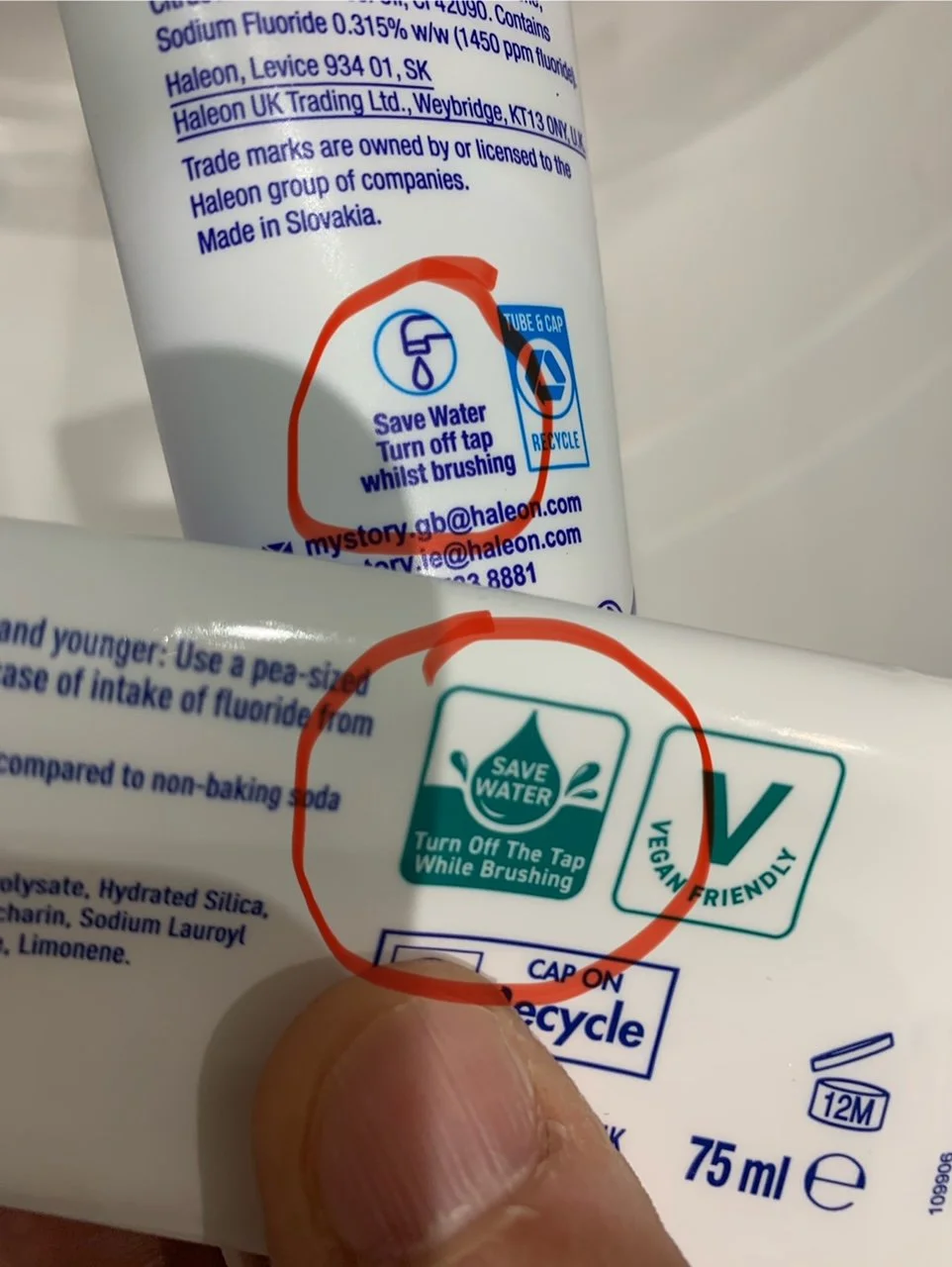
When you brush your teeth tonight, have a look at the tub of your toothpaste and with 100% certainty you’ll find something like the above printed on it: “Save water. Turn off the tap whilst brushing.”
There is nothing controversial about this, in fact, turning off the tap whilst brushing is a very good idea.
Nor is it is surprising, as it is one of those positive interventions with little cost that have definitely entered collective consciousness. Bizarrely, I even remember our high school teacher back in Germany 20 years ago reminding us to switch off the tap whilst brushing our teeth. It is something that has been firmly ingrained for sure.
So what’s the bother then?
Well there shouldn’t be one, if it weren’t for the fact that if a certain message gets hammered into us over and over it has the following two unintended (or maybe intended?) psychological consequences:
1. Due to the increased salience of this one message, we may disregard und undervalue other ways of saving water that might actually be more effective. We’ve done our bit by turning off the tap and are now less receptive to further interventions or alternatives.
Yes, turning off our taps saves between 6 and 12 litres of water each time we brush our teeth. But if, just to name one example of an alternative, we were to swap our beef burger with a veggie burger for dinner, we’d save over 2000 litres of water. In other words hundreds times more, a much more effective intervention.
2. By focusing on individual contribution and personal responsibility we are likely to neglect systemic issues.
This is because as humans we struggle to hold several causative theories at a time. If we see ourselves responsible for saving water, we are automatically more likely to let water companies off the hook. And vice versa. If we focus on individual responsibility, we automatically give less weight to corporate and state responsibility.
The amount of water we save by turning off the tap is dwarfed by the over 3 billion litres of drinking water that water companies in England and Wales waste every day. Not to mention the amount sewage that ends up in our rivers and waterways on a daily basis.
So why is it then that we are so familiar with idea of switching off the tap to save water but much less so with the idea of eating less beef to save water? Might the beef industry have anything to do with it?
Exasperated individuals
As individuals, we’ve done everything. We’ve become vegan, even though processed veggie sausages and too many beans give us flatulence. Every time we’re at the supermarket and realise we’ve forgotten our bags for life, we almost suffer a heart attack. Wherever we go, we bring our refillable water bottles with us.
We might have not all have gone as far as staging a school strike or getting imprisoned for demonstrating, but we have definitely tried to do our bit, made sacrifices and, above all, worried a lot.
And 20 years later…., nothing.
The train is still heading at full speed towards the abyss.
We’ve been told the importance of recycling for decades, yet global recycling rates stay stubbornly well below 10% and deep down we have the horrible certainty that it all ends up in the same giant landfill anyway (or on one of those giant trash islands in the Pacific Ocean.)
Why is it not working? Could it be that the idea of personal responsibility has its severe limits? Unless you are an individual with enormous personal wealth or corporate or political power, you simply don’t have that much influece.
But if it was all just a big fat lie, why did we believe it so easily?
How did we come to internalise the idea that structural problems are our personal responsibility?
It was all by design
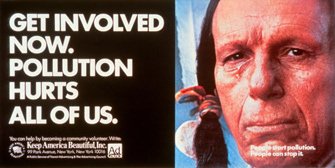
The campaign “Keep America Beautiful” was made to look like it came from environmental campaigners.
But in fact it was created by the very corporations that introduced disposable packaging to the mass market, among them Coca-Cola. They wanted to sell more products, but knew it would result in more rubbish and litter everywhere, with the resulting negative consequences for their PR. They therefore needed to shift the blame from themselves to the consumer.
These are companies that have foisted trillions of disposable plastic bottles onto the world, yet in a genius marketing coup they managed to shift to focus of attention away from themselves to the consumer. “People start pollution. People can stop it.”
In the UK, the campaign “Keep Britain tidy” is heavily financed by corporations such as Nestlé.
The personal carbon footprint
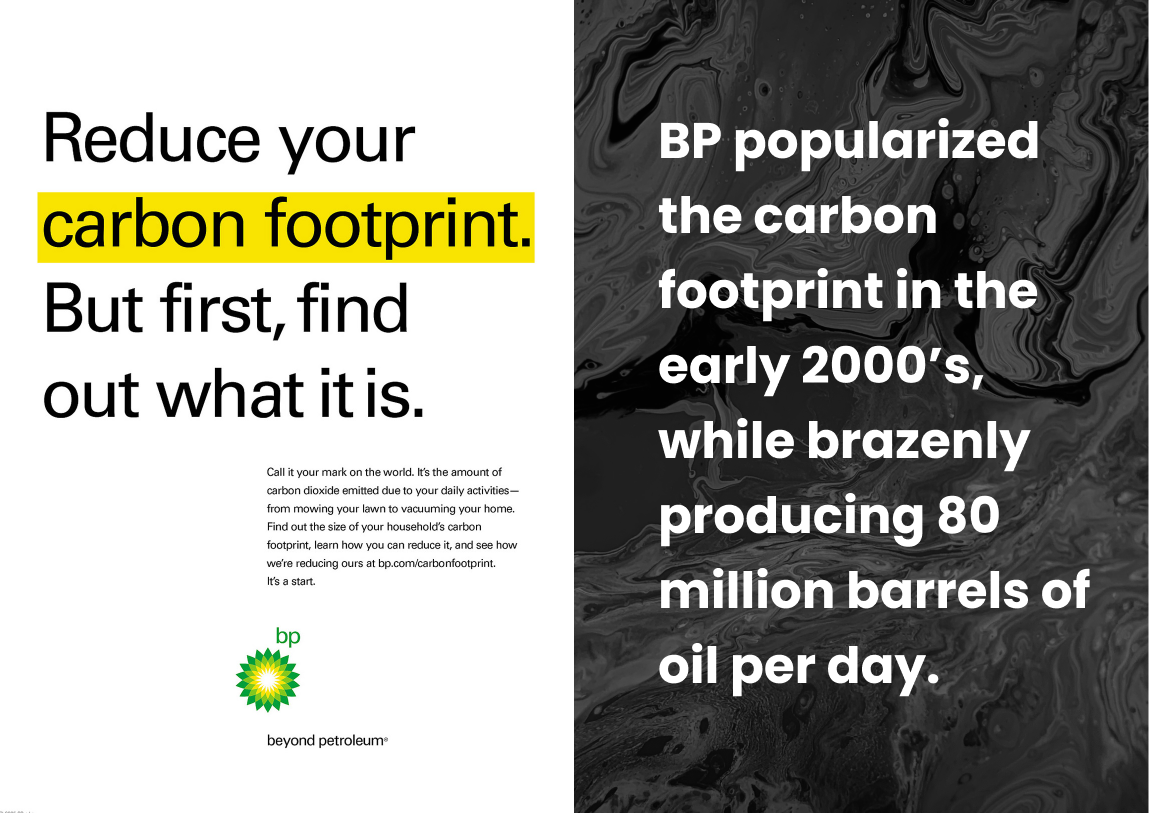
Another genius marketing coup that we have completely internalised is that of the personal carbon footprint.
It is so commonplace that we have almost forgotten that it wasn’t the idea of let’s say Greenpeace but was cooked up by British Petroleum (BP) with the help of advertising agency Ogilvy & Mather.
The system is the problem
Rather than looking at isolated cases and blaming specific corporations, we have to recognise that the overall model is the problem. It’s our system that doesn’t work.
From the 1980s onwards, the Western World has adopted a specific type of capitalism that completely ignored the weaknesses in the capitalist model. Rather than seeing corporate greed and personal selfishness as problems that need to be regulated, it has framed them as virtues.
The presidency of Ronald Reagan and the premiership of Margaret Thatcher fetishised the individual and completely neglected the importance of society, collective responsibility and the government.
We’ve deeply internalised this model without realising it. The consequences for society and all of us are devastating. Whenever a problem befalls us, whether it is obesity, mental health problems or homelessness, we immediately blame ourselves, rather than looking at the structural issues that have led us to where we are.
There is something you can do
We can actually change things. It has been done many times before.
The answer is not to listen to people and not to vote for parties that perpetuate the same lies and continue to believe in the same systems that have proven not to work.
Inform yourself and vote for the right parties.
And turn off the tap and eat less meat. These things do actually have an impact. But we need to do them in combination with thinking about the bigger picture.
———————————————————————————————————————————————————————————————
References:
It’s On You: How The Rich and Powerful Have Convinced Us That We’re To Blame For Society’s Deepest Problems (2026), Nick Chater & George Loewenstein
The Invisible Doctrine (2025), George Monbiot & Peter Hutchison
The Big Myth: How American Business Taught Us To Loathe Government And Love The Free Market (2023), Naomi Oreskes & David M. Conway